
Why Auto Parts Store Clerks Might Mislead You About Car Repairs
Your Check Engine Light pops on. Panic sets in. You pull into a big-box auto parts store because the sign in the window says: "FREE CHECK ENGINE LIGHT DIAGNOSIS."
A friendly employee comes out, plugs a little handheld device into your dashboard, and says: "Looks like you have a P0171 code. It says 'Oxygen Sensor.' We have that in stock for $150. Do you want to buy it?"
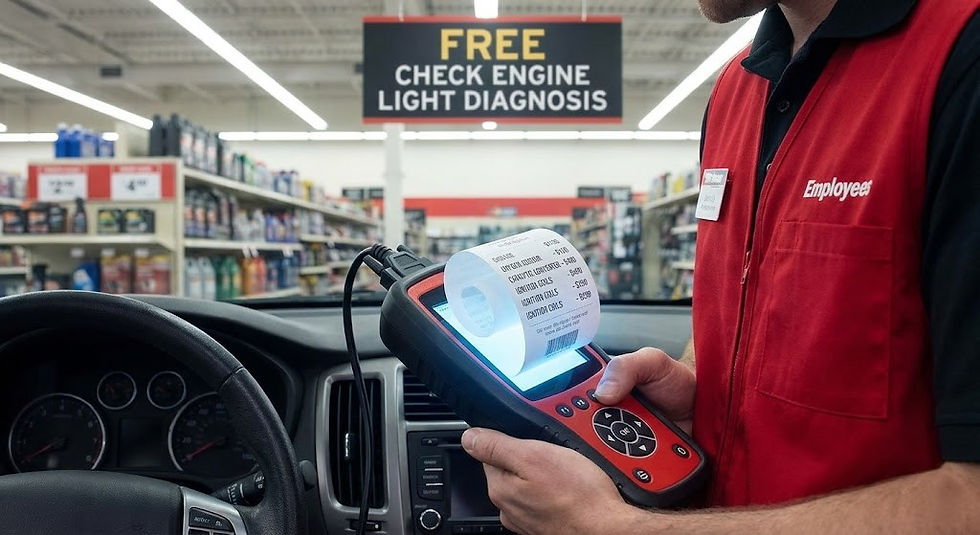
You buy the sensor. You spend Saturday afternoon struggling to install it. You clear the code. The next day, the light comes back on.
Congratulations, you just fell for the "Retail Trap."
As a former technician, I need to let you in on an industry secret: A Diagnostic Trouble Code (DTC) is NOT a diagnosis. And believing the guy behind the counter can fix your car is an expensive mistake.
The "Clerk" Reality Check
Let’s be brutally honest for a second. The person standing behind that counter is a Retail Clerk, not an Automotive Technician.
Their expertise is inventory management and retail sales, they may have fundamentals of a working engine maybe even electron theory but they certainly are not technicians. Think about it logically: A skilled, experienced automotive technician makes great money—often double or triple what a retail associate earns. Why would a "real" technician take a massive pay cut to stand at a cash register and sell car wax? They wouldn't.
If the person reading your code was actually capable of diagnosing a modern vehicle, they would be working in a shop, not scanning items for minimum wage. You are taking mechanical advice from someone whose primary training is in sales, not service.
The Thermometer Analogy
Here is the best way to understand why the parts store scan is misleading.
Think of a Check Engine Light like a Fever. If you feel sick and take your temperature, the thermometer might read 102°F. That number tells you something is wrong, but it doesn't tell you what is wrong. It could be the flu, an infection, or heat stroke.
A Check Engine Code works the same way.
If you get an "Oxygen Sensor Lean" code, the sensor is acting like the thermometer. It is reporting that the engine is "sick" (running too lean).
The Reality: The sensor is usually working perfectly! It is doing its job by reporting the issue. The actual "infection" is likely a vacuum leak, a dirty injector, or low fuel pressure.
If you replace the sensor, you are just blaming the thermometer for the fever. You haven't cured the infection, and the fever (the light) will come right back.
The Conflict of Interest
Why do parts stores do this? Because they don't sell "fixing a vacuum leak." They don't sell "soldering a broken wire." They sell parts.
Their computer system is programmed to link every code to a sellable SKU.
Code P0300 (Misfire) ➡️ Sell Spark Plugs and Coils.
Code P0420 (Catalyst Efficiency) ➡️ Sell a $400 Catalytic Converter.
They are giving you a shopping list, hoping one of the items fixes the problem. And guess who pays for the trial and error? You.
Stop Guessing. Get Real Help.
I am not saying you need to rush to the dealership and pay $250 an hour every time a light comes on. But you do need a strategy that isn't just "Guess and Check."
This is where I come in.
I offer Technical Diagnosis Assistance. Instead of throwing money at parts you might not need, I help you interpret what the car is actually telling you.
I can review your scan data.
I can help you isolate the root cause (is it the sensor, or the wiring?).
I can guide you to the actual fix, often saving you hundreds in unnecessary purchases.
My Rule of Thumb: Use the parts store to BUY the parts you need. Do not use the parts store to TELL YOU what you need.
If you are staring at a Check Engine Light and a confusing list of codes, reach out to me. Let's figure out what's actually wrong so you only fix it once.
If you need assistance with your check engine light diagnosis don't guess at your repairs, ask the professionals.


Comments