
Stop Paying for the "Parts Cannon": Is Your Mechanic Fixing Your Car or Just Guessing?
It is the most frustrating scenario in car ownership:
Your check engine light flicks on. You take the car to the shop. They tell you it needs a specific part—maybe a sensor or a valve—and charge you $1,100. You pay the bill, confident the problem is solved.
Two days later, you are driving down the highway, and ding! The light is back on.
You go back to the shop, and they give you a new explanation. "Well," they say, "That first part was definitely bad, but now the computer is showing us that the catalytic converter is also bad. That will be $3,500."
Did your car actually break two different things in 48 hours? Probably not. You have likely just become the latest victim of "The Parts Cannon."
This is a dirty little secret in the auto repair industry where technicians fire parts at a car until the problem goes away—and you pay for every single bullet

What is the "Parts Cannon"?
The "Parts Cannon" is slang used by honest mechanics to describe lazy diagnostics. Instead of finding the root cause of a problem, a technician simply replaces the most common parts associated with a symptom, hoping one of them fixes it.
It’s expensive, it’s wasteful, and it’s happening more often than ever in 2026. To understand why, you have to understand the difference between a diagnostic trouble code (DTC) and a real diagnosis.
The "Code Reader" Myth
The biggest misconception consumers have is that modern cars "tell the mechanic what is wrong." This is false. The computer does not tell the mechanic the solution; it tells them the symptom.
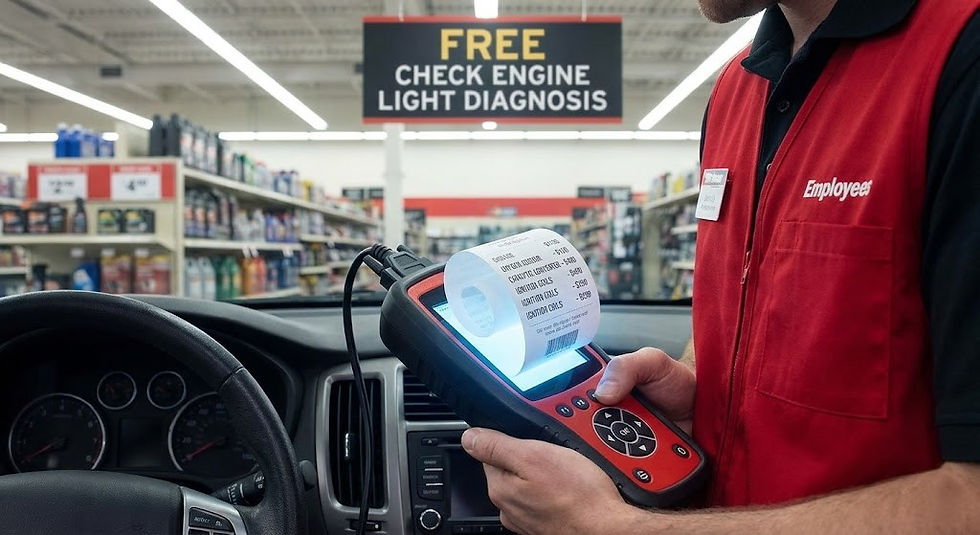
When a mechanic plugs an OBD2 scanner into your car, they get a code like P0300 (Random Misfire) or P0171 (System Too Lean).
A Code is NOT a Diagnosis.
A Code is a Zip Code. It tells the technician which neighborhood the problem is in, but not which house.
The Real-World Example: Let’s say your car throws a code for an "Oxygen Sensor Lean" (P0171).
The "Parts Cannon" Tech: Sees "Oxygen Sensor" on the scanner screen. Replaces the Oxygen Sensor. Charges you $1,100.
The Reality: The Oxygen Sensor was working perfectly. It was reporting a "Lean" condition because there was a vacuum leak in a $10 rubber hose elsewhere in the engine.
The Result: The new sensor reads the exact same error because the vacuum leak is still there. You just wasted $1,100.
A real diagnostician would have looked at the live data stream, tested the sensor to see if it was lying, and smoke-tested the engine to find the leak before selling you a single part.
Why Do Shops Do This? (The 3 Hidden Incentives)
If the Parts Cannon is so bad, why is it standard practice at so many dealership service centers and chains? It comes down to three factors:
1. The "Flat Rate" Pay System Most mechanics are paid "Flat Rate." They get paid a set amount of hours for a job, regardless of how long it takes.
Replacing a part pays well. It’s purely mechanical work.
Diagnosing electrical problems pays poorly. It takes time, brainpower, and patience.
The Incentive: It is more profitable for a technician to guess and swap a part quickly than to spend 2 hours testing circuits.
2. The Brain Drain As we’ve discussed in previous posts, Private Equity buyouts are driving experienced Master Technicians out of the industry. Shops are replacing $50/hour experts with $20/hour juniors that are generalized parts changers. These younger techs often don’t know how to use an oscilloscope or read fuel trim data. They rely on "Flowcharts" and Google. If Google says "replace the coil," they replace the coil.
3. The "Service Writer" Disconnect The person selling you the repair (the Service Advisor) is usually a salesperson, not a mechanic. They want to sell a "fix" confidently. Telling a customer "We need 3 hours of diagnostic time at $180/hour just to find the problem" is a hard sell. Selling a "Tune Up" sounds like a solution. So, they sell the part, not the testing.
How to Protect Your Wallet (Scripts You Can Use)
You don’t need to be a mechanic to stop the Parts Cannon. You just need to ask the right questions before you authorize the car repair estimate.
Script #1: The Verification Question
You: "You said I need a new Mass Airflow Sensor. Did you test the old one and verify it had failed, or is that just the most likely fix for this code?"
Why it works: It forces them to admit if they actually tested the component or if they are guessing.
Script #2: The Guarantee
You: "If I authorize this $600 repair and the Check Engine Light comes back on with the same code tomorrow, what is your policy? Do I get a refund, or will you credit this money toward the real fix?"
Why it works: A shop that is guessing will start backpedaling immediately. A shop that is confident will stand by their diagnosis.
Script #3: Ask for the Evidence
You: "Can I see the freeze-frame data or the test results that led you to this conclusion?"
Why it works: Even if you don't know what freeze-frame data is, asking for it signals that you are an educated consumer. A "Parts Cannon" shop usually won't even have this data saved.
The IQ Auto Solutions Approach: Accuracy Over Guesswork
At IQ Auto Solutions, we believe that Diagnosis is a Service, not a guess.
True diagnosis requires reviewing the live data stream, understanding the relationship between sensors, and verifying a failure before a new part is ever unboxed.
If you are stuck in a cycle of repairs—where the shop keeps throwing parts at your car and the bill keeps climbing—stop spending money.
We can review your repair history, analyze the technician's notes (or lack thereof), and determine if you are being properly diagnosed or taken for a ride. We act as your expert second opinion for car repair, ensuring that the repair you pay for is the repair you actually need.


Comments